“I have learned more
about our heritage from this web site in only a few minutes than I learned in
my entire life.”
Joseph (USA) - A
visitor of our web site
Dobrodošli/Üdvözöljük
Welcome to our web site
www.vendvidek.com!
created: 2005
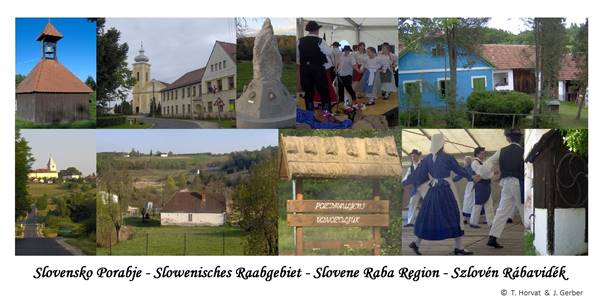
About us
We are Tibor Horvat, MSc, and Joël Gerber, MA, and we run this web page completely
on our own. Mr Horvat holds a Master’s degree
in Economics, Political Science and Media Studies, and Mr Gerber holds a
Master’s degree in History and English Language and Literature. Furthermore, we are both certified teachers of German as a
foreign language / German as a second language.
Due to our profound interest in ethnic minorities, we decided to launch
a web page on the Slovenes living in Hungary in 2005. The project of our
website, to which we have been devoting ourselves with great commitment in
addition to our actual professional activity and under our own auspices and
without any financial support, enables us to discuss the eventful history and
diverse culture of the Slovene Raba Region. Furthermore, Mr Horvat
has an own, very personal connection to the “Vendvidék”
since he hails from Apátistvánfalva/Števanovci from his father’s side.
In the year 2005 we were the first to start making available to the
general public extensive online
information on the Slovene Raba Region/Vendvidék.
Mr Horvat, who is a native speaker of both Hungarian
and German, translated the Hungarian source texts into German. Subsequently, Mr
Gerber, a native speaker of German who has studied English Language and
Literature, attended to the translation from German into English.
The aim
and vision of our web page
According to the 2011 census, the
community of the Slovenes in Hungary consists of almost 3 000 people and is in
danger of falling into oblivion. With our website we want to make a
contribution to the preservation of their cultural heritage. It is our goal to
introduce the Slovene population living in the Hungarian Raba Region to a
broader international public and in doing so to particularly inform the
Slovenes from the Raba Region, and their descendants respectively (hence the
bilingual version of our home page) living in the English and German-speaking
areas about their origin in their mother tongues. Driven by our distinct
interest in the history and culture of ethnic minorities, we therefore
explicitly pursue the goal of an active promotion of minorities, in our case
the preservation of the manifold history and language, and the traditional habits
of the Slovenes from the Raba Region in the cultural memory of the people
living outside the “Vendvidék”.
In the last few years, we have
frequently attended the public events and festivities taking place in the seven
Slovene villages of the Porabje periodically, not
least in order to gain personal impressions on site which we then publish as
brief reports under the rubric “Our Reports” on our website. This
journalistic work makes it possible to keep the Slovenes from the Raba Region
living outside the Porabje, who are neither able to
speak Slovene nor Porabian, up-to-date on the latest
developments in their region of origin, and to give them an understanding of
the culture of their ancestors respectively.
Many people have already become enthusiastic about the
Slovene Raba Region. Now it is your turn to go on an expedition to the
fascinating Raba Region and to get to know the rich history and culture of the
people of the “Vendvidék”!
* The “Vendvidék” is also
called “Slovene Raba Region”.
„Vendvidék“:
term and geographic location
“Vendvidék”
is a Hungarian expression meaning “the country of the Wends/Windish-land”. This term primarily designates
respectively designated the Slavs/Slovenes living in the south-eastern Germanic
language area. Due to the immigration of the Slavs into the German-speaking
area in the 7th and 8th century, this term was used by
the Germanic peoples as a synonym for “the foreign”. This
appellation became a loan word in Hungarian, and even today it is still a term
commonly used in everyday speech to describe the Slovenes living on Hungarian
territory (Hungarian vend, and vendek
in the plural form respectively*). The area itself became known by the name of
“Raba Region”, and of “Slovene Raba Region” (Slovene Porabje/Slovensko Porabje) respectively. This terminology, and the
practice to refer to the Slovenes in Hungary as “Slovenes from the Raba
Region” respectively originates from Slovenia itself. The expression
“Slovenes from the Raba” which designates the Slovenes living in the
catchment area of Monošter/Szentgotthárd
appeared in the Slovene press already after the First World War. After the
Second World War, they used to be called “Slovenes from the Raba river
bank” more frequently as well. In a geographical, cultural, linguistic,
and an ethnic point of view, the Raba Region/Porabje
belongs to the Mura Region/Prekmurje (Slovenia).
These two areas once formed a geographical unity until they were separated in
1919. The Mura Region was annexed to newly-founded Yugoslavia (SCS state),
whereas the Raba Region remained under Hungarian sovereignty. Due to the Treaty
of Trianon (1920) and later as a consequence of the
existence of the Iron Curtain, the Slovenes from the “Vendvidék”
were separated from the rest of the Slovene people for decades.
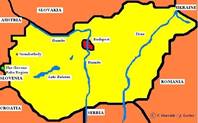
The “Vendvidék” is located
in the border triangle of Slovenia, Hungary, and Austria, in the catchment area
of the border town of Monošter/Szentgotthárd and is flown through by the small
River Raba, which gives this hilly region the name of “Raba
Region”. The picturesque national park of Őrség
(Slovene Goričko),
which lies in the south-west of Hungary and is famous for its rich flora and
fauna forms also part of the “Vendvidék”. Within the Raba Region, which extends over
an area of about 94 km2, there are seven
Slovene-speaking villages: Gornji Senik/Felsőszölnök, Dolnij
Senik/Alsószölnök,
Sakalovci/Szakonyfalu, Slovenska ves/Rábatótfalu,
Števanovci/Apátistvánfalva,
Ritkarovci/Kétvölgy,
and Andovci/Orfalu. The
small border town of Monošter/Szentgotthárd with its inhabitants of Slovene and
Hungarian descent is the economic and cultural centre of the Slovenes from the
Raba Region. The Slovene minority in Hungary lives in the Raba Region, in
Szombathely (the principal town of Vas County), and in other parts of this West
Hungarian county, furthermore in the counties of Somogy,
Győr-Moson-Sopron and Budapest, and dispersed in other regions
of Hungary.
Family research in English and German owing to www.vendvidek.com
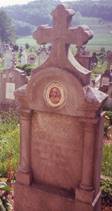
Thanks to our
category of “Old Tombstones”, for which we have photographed the
tombstones of the cemeteries of the seven villages in the Porabje,
it is now also possible for the descendants of the Slovenes from the Raba
Region living overseas to see the last resting places of their deceased family
members and to do family research with the help of the epitaphs shown on our
website, as Mr Chuck Doncsecz Sr
from Bethlehem, PA, USA points out in our guestbook (10/06/2006):
„Great information. Attempting to trace family tree back. I will find your site very useful.“
From the USA to the
„Vendvidék“
owing to www.vendvidek.com (our English-speaking travel guidance on
site)
What is more, we have already guided members of the Slovene diaspora in
the USA through the Raba and the Mura Region several times and have introduced
them to their historical roots at first hand making them perceive the cultural
diversity of the region as if they were a part of it; a personal experience,
which they would have hardly had without our personal dedication, as for
example also Jeanne Czvitkovics Brown from San Diego,
CA, USA, whom we guided through the “Vendvidék”
in June 2007, takes into consideration in her travelogue published on our
website:
„With special thanks to Tibor Horváth
and Joël Gerber, without whose help this journey
would never have been possible.”
Travel Reports
Information in English and
German for the first time owing to www.vendvidek.com
The numerous positive entries in our guestbook
encourage us on the one hand to continue dedicating ourselves to our project in
the future, and are on the other hand an evidence for the importance of our
pioneer work. Because he who wanted to get informed about the “Vendvidék” before our web page had been
launched and who possessed neither language skills in Slovene nor in the
regional variation of Slovene, a circumstance which, for example, applies to
the vast majority of the Slovenes from the Raba Region living in the U.S.
diaspora, used to search unsuccessfully for any traces of their region of
origin. In this context, see the comment of the user Mr Joseph Horvath from
Marshall, Virgina, USA (07/05/2006):
“Thank
you so very much Tibor and J. Gerber for keeping our History alive! I have
learned more about our heritage from this web site in only a few minutes than I
learned in my entire life of 40 years. I am also proud to use the history and
photos of Apátistvánfalva to honor my father, Steve Horvath, who passed away this July
2, 2006. This means more to me than words can express. Thank you.”
Another U.S. citizen with “Windish”
roots, Mr Ron Dixon, made a similarly positive statement about our website
(08/02/2009):
„I just discovered this website! Awesome! I
had no idea this region had a name – Vendvidek.
My ancestors came from Eckersdorf according to Ellis
Island records and I recently figured out this is the other name of Szakonyfalu. Thanks for the pictures of Szakonyfalu.
Now I can see where my Düh family came from.
[...]“
Or also Monica Raffaele Adamo (04/07/2006):
„For now I can say that I like this website,
I think it says a lot about the Raba region, from many different point of
views. Well done Tibor Horvath and J. Gerber, it is important to preserve
traditions and spread knowledge about small regions and minorities. Ciao!“